Skip to content
A tree that looks healthy in the summer can split apart during a winter Nor’easter and land on your roof before the storm season even peaks. On the South Shore, that’s not a rare event —it’s seasonal and a risk all New England homes face when they have trees on their property.
Tree storm preparation isn’t a last-minute task. It’s an ongoing process of professional pruning, structural assessment, and species evaluation that reduces the risk of damage from the Nor’easters, coastal wind events, and occasional tropical systems that hit towns like Quincy, Hingham, Scituate, and Marshfield throughout the year. Salt air, sandy coastal soils, and dense residential tree cover all raise the stakes here compared to inland Massachusetts.
This guide covers how to assess your trees, how professional pruning reduces failure risk, which species hold up best in Nor’easters, and what storm-damage tree care looks like after high winds pass through. Now let’s take a closer look at what local homeowners can do to prepare trees for seasonal storms.

What Tree Storm Preparation Actually Involves
Good tree storm preparation identifies structural weaknesses and reduces wind load before a storm — not after. Many defects (including bark, co-dominant stems, root decay, internal fungal infection) aren’t visible without a trained eye.
A professional hazard assessment evaluates:
- Overall crown and trunk structure and stress points
- Presence of dead wood in the canopy signaling potential problems
- Root zone condition (critical in South Shore’s shallow, sandy soils)
- Signs of disease or pest activity that can weaken trees
- Proximity to your house, power lines, or vehicles
- Professional recommendations to prepare trees for seasonal storms
Common structural defects that cause storm failures:
| Defect | Why it fails |
| Co-dominant stems with included bark | No solid wood-to-wood connection; splits under sustained wind |
| Dead limbs in the upper crown | No flexibility — breaks instead of bending |
| Cracks/splits at branch unions | Existing weak point fails under load |
| Trunk cavities or decay columns | Reduced structural capacity |
Professional Pruning: The Most Effective Storm Preparation for Trees
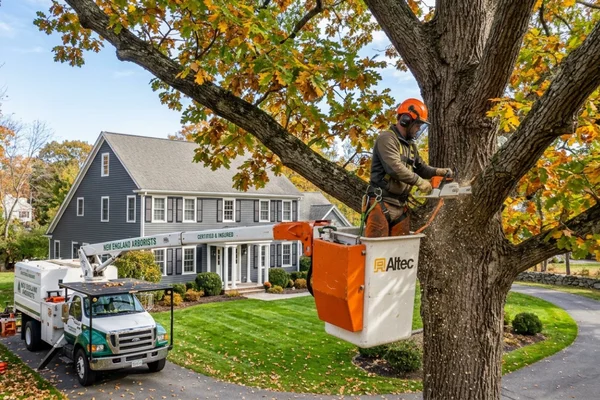
Proper storm preparation for trees follows local guidelines and recommendations from local arborists and tree care experts. Preparing for the Nor’easter storm season is not the same as topping or cutting a tree down to size. Topping creates weak, fast-growing regrowth and accelerates decline.
- Crown thinning — opens the canopy so wind passes through instead of pushing against it like a sail. This is often the difference between a tree that survives a 60–70 mph coastal gust and one that fails at the base.
- Crown raising — removes low branches, reducing debris that can pile against a structure during flooding or storm surge.
- Deadwood removal — non-negotiable. A dead limb in a mature oak or maple can weigh hundreds of pounds and offers zero flex in high wind.
When to schedule pruning:
| Task | Best timing |
| Routine structural pruning | Late winter–early spring, before new growth |
| Hazardous deadwood removal | Anytime it’s identified — don’t wait for a “pruning season” |
| Pre-storm inspection | Early fall, ahead of Nor’easter season (roughly October–March) |
South Shore Species: Storm Performance at a Glance
| Species | Storm Risk | Notes |
| Red & white oak | Low (when healthy) | Deep roots anchor well; watch for dead limbs in older trees |
| Eastern white pine | Moderate | Open-grown trees do fine; pines newly exposed after neighboring removals are prone to uprooting |
| Silver maple | High | Weak wood, fast growth, frequent co-dominant stems — a leading cause of storm claims in eastern MA |
| Ash | High | Emerald ash borer has left many already dead or structurally compromised |
| Elm / Bradford pear | High | Weak branch structure, prone to splitting |
Coastal factor: Salt air exposure in Scituate, Cohasset, Marshfield, and Hull weakens branch tissue and thins canopies over time — even in species that otherwise perform well.

When a Tree Should Be Removed Before Storm Season
Deciding what to remove is part of tree storm preparation too — not every tree can be saved with pruning alone. Removal is the right call, not pruning, when a tree shows:
- Mushroom conks or shelf fungi at the trunk or root flare
- A hollow sound when the trunk is tapped
- Bark separating from the trunk in large sections
- A sudden or worsening lean, especially after wet weather
- Decay affecting roughly a third or more of trunk diameter
- Position where any failure would strike a structure or power line
Some South Shore towns, including Quincy and Hingham, require permits for removing trees above a certain diameter — check local tree bylaws before work begins. Planned removal is almost always cheaper than emergency removal after a tree has already come down.
After a Nor’easter or Coastal Storm Hits
Post-storm tree work is dangerous — hanging limbs, root balls under tension, and trees leaning on power lines are not DIY situations. Professional post-storm tree care services can make recovery safe and easy.
Safe post-storm checklist:
- Inspect from a distance before approaching any tree
- Watch for hanging limbs (“widow-makers”) held up by other branches
- Note any new or worsening lean, or a lifted root ball
- Treat any tree touching a power line as energized — call the utility company, not a chainsaw
- Photograph all damage before cleanup, for insurance purposes
Insurance basics: Most homeowners policies cover tree removal when a tree falls on a covered structure (often up to $500–$1,000 per tree). A tree that falls in the yard without hitting a structure is usually not covered. As with all financing and insurance issues, check with your policy provider for storm damage specifics well ahead of the seasonal Nor’eaterns.
Shore Tree Service provides professional post-storm tree care across Quincy, Braintree, Weymouth, Hingham, Milton, Plymouth, and the surrounding South Shore towns—including emergency response when a tree or limb poses an immediate threat.

Long-Term Maintenance as Ongoing Storm Preparation
The most storm-resistant trees are the ones maintained consistently, not just inspected once before a big storm.
| Property type | Recommended inspection frequency |
| Standard residential lot | Every 1–2 years |
| Large properties / significant tree cover | Annually |
| Trees near structures, power lines, or with known defects | Annual or more frequent |
| Ash trees (due to emerald ash borer) | Immediate assessment if not recently checked |
Winter moth and spongy moth defoliation, repeated two or more years in a row, also weakens trees and is worth flagging during routine visits.
Get Expert Tree Care Help to Master Tree Storm Preparation
If you have trees near your home, garage, or power lines on the South Shore, don’t wait for the next Nor’easter to find out if they’re safe. Shore Tree Service offers professional tree storm preparation — inspections, pre-storm pruning, hazard removal, and storm damage tree care — across Quincy, Braintree, Weymouth, Hingham, Milton, Scituate, Marshfield, Cohasset, and Plymouth.
Licensed, insured, and familiar with South Shore soils and coastal conditions. Contact us for a free onsite estimate, or call directly for emergency storm response.

FAQs
What should I do to prepare my trees before storm season on the South Shore?
Schedule a professional inspection to catch hazardous limbs and structural defects, have dead wood and co-dominant stems pruned, and identify any trees in advanced decline that should come down before storm season. Document your property with photos beforehand for insurance purposes.
Can trees fall in 50 mph winds?
Yes. Trees with root damage, trunk decay, included bark, or significant deadwood can fail well below 50 mph. Healthy, well-maintained trees are more resistant, but South Shore’s shallow, sandy soils make wind-firmness a real concern even for otherwise sound trees.
Does homeowners insurance cover tree cleanup after a storm?
Usually only if the tree falls on a covered structure, typically up to $500–$1,000 per tree. A tree that falls in the yard without hitting anything is generally not covered. Photograph damage and keep all contractor documentation for your claim.
How do I know if a tree needs to come down before the next Nor’easter?
Watch for fungal conks, a hollow-sounding trunk, separating bark, a new or worsening lean, major root damage, or a mostly dead canopy. If you’re unsure, a licensed arborist can give you a clear call on whether to preserve or remove it.
How is a Nor’easter different from a hurricane when it comes to tree damage?
A hurricane typically brings a short, intense burst of high wind. A Nor’easter often lingers for a day or more and combines sustained wind with heavy, wet, clinging snow or rain that adds significant weight to the canopy. That combination of prolonged wind load and snow-loaded branches is why Nor’easters cause so much limb and tree failure on the South Shore, even when peak gusts are lower than a hurricane’s.
Should I stake or wrap young trees before a storm?
Newly planted trees with an undeveloped root system benefit from staking with a soft, flexible tie that allows some natural movement — over-tightening can actually weaken the trunk. Mature, established trees generally should not be staked; focus on pruning and structural assessment instead. Mulching around the base (while keeping the root flare exposed) also supports root stability heading into storm season.
Which tree species hold up best in New England wind storms?
Deep-rooted, taprooted species such as oak, hickory, beech, and ginkgo tend to perform best in high wind, while shallow-rooted species are more prone to uprooting. On the South Shore, this matches what local arborists see in the field: oaks with healthy root systems tend to outperform silver maple, ash, and other shallow- or weak-rooted species during Nor’easters.
Is my neighbor’s tree my responsibility if it falls on my property?
In general, homeowners insurance covers tree damage to your home regardless of where the tree was originally rooted, so a neighbor’s tree falling on your house is typically handled through your own policy rather than theirs. If a neighboring tree is visibly dead, leaning, or hazardous before a storm, document it with photos and send a written notice to the owner to help clarify liability if it fails—and policies vary, so confirm specifics with your insurer.
How close is too close for a tree to be planted near my house?
There’s no single rule, but as a general guideline, a large shade tree’s mature canopy and root spread should have enough clearance that a full-height failure wouldn’t land directly on the roofline — often 15–20 feet or more for large species like oak or maple, closer for smaller ornamental trees. An arborist can evaluate existing trees near your foundation and recommend pruning, cabling, or removal based on species, health, and proximity.