Skip to content
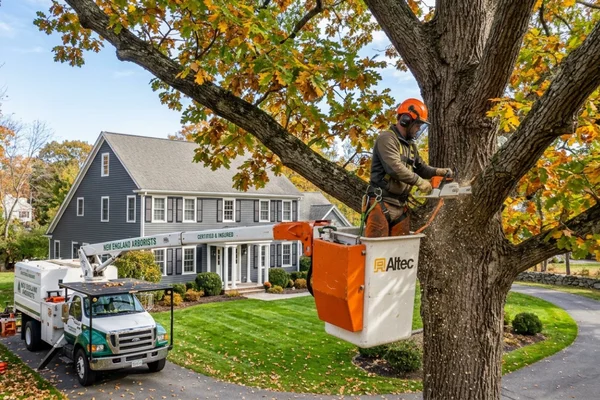
One of the best benefits of tree trimming is that it helps trees grow stronger, live longer, and better withstand Massachusetts storms. Proper pruning removes hazardous branches, improves airflow, reduces disease, and protects nearby structures. This guide explains when to trim trees, why timing matters, and how certified professionals protect mature trees throughout the South Shore.
The South Shore of Massachusetts is known for its mature oaks, maples, pines, and other native trees that add beauty, shade, and value to residential properties. However, the region’s coastal climate also exposes trees to strong nor’easters, salt air, heavy snow, summer drought, and destructive pests that can weaken branches and shorten a tree’s lifespan.
Without regular maintenance, trees become more susceptible to storm damage, disease, and structural failure. That’s why understanding the benefits of tree trimming and pruning is essential for protecting both your landscape and your investment.
In this guide, we’ll explain the biggest benefits of routine pruning, the best time to trim trees in South Shore, MA, and when to call a trusted South Shore tree-pruning service or local tree-trimming professional. Let’s take a closer look at the benefits of tree trimming and how professional pruning protects your trees throughout every season.
Key Takeaways
- Professional tree trimming promotes healthier, stronger trees by removing dead, diseased, and weak branches while encouraging balanced growth and improved structural integrity.
- Routine pruning reduces the risk of storm damage by eliminating hazardous limbs before nor’easters, heavy snow, and coastal winds can cause costly property damage.
- The best time to trim most trees in South Shore, MA, is late winter, when trees are dormant, and pruning supports faster healing and healthier spring growth.
- Proper pruning improves airflow and sunlight penetration, helping reduce fungal diseases, discourage pests, and extend the lifespan of mature landscape trees.
- Hiring a licensed local tree trimming professional ensures the right techniques are used for Massachusetts tree species, protecting your investment and avoiding harmful practices like tree topping.
- Regular tree maintenance increases curb appeal and property value while helping homeowners identify potential hazards before they become expensive emergency repairs.

WHAT PROFESSIONAL TREE TRIMMING ACTUALLY DOES FOR YOUR TREES
One of the greatest benefits of tree trimming is that professional tree care does much more than improve curb appeal. Proper pruning is a proactive form of tree care that strengthens branch structure, encourages healthy growth, reduces safety risks, and helps trees better withstand the demanding weather conditions common across the South Shore. When performed correctly, tree trimming is an investment in both the health of your landscape and the long-term value of your property.
Directs Healthy Growth
One of the biggest benefits of tree trimming is its impact on a tree’s growth. Every pruning cut affects where the tree sends its energy. By removing dead, diseased, damaged, or rubbing branches, the tree can redirect nutrients and resources toward healthy limbs, stronger roots, and new growth rather than sustaining failing wood.
Over time, this creates a stronger, more balanced canopy that is less prone to splitting and structural failure. Proper pruning also encourages better branch spacing, reducing weak attachments that often break during high winds or heavy snow.
Improves Tree Health and Disease Resistance
Crowded canopies trap moisture, limit airflow, and create ideal conditions for fungal diseases and insect infestations. One of the key benefits of pruning trees is improving air circulation and allowing more sunlight to reach the interior of the canopy.
For South Shore homeowners, this is especially important as trees face ongoing threats from coastal humidity, spongy moths, winter moths, and other common Massachusetts pests. Removing infected or damaged limbs early can also help prevent problems from spreading throughout the tree.
Reduces Storm Damage and Safety Risks
Massachusetts weather is unpredictable. Nor’easters, coastal windstorms, heavy snow, and ice place tremendous stress on mature trees each year.
Proper tree trimming removes weak, cracked, or overextended limbs before they become hazards. It also creates a canopy that allows wind to pass through the branches rather than be pushed against a dense wall of foliage. These structural improvements can significantly reduce the likelihood that broken limbs will damage homes, vehicles, fences, or power lines.
Common Professional Pruning Techniques
Professional tree trimming is tailored to each tree’s species, age, structure, and location. Rather than using one method for every tree, arborists select the most appropriate pruning technique to encourage healthy growth and long-term stability.
| Pruning Technique | Purpose | Best Used For |
| Crown Thinning | Improves airflow and sunlight penetration | Dense, mature canopies |
| Crown Raising | Removes lower limbs for clearance | Sidewalks, driveways, roofs, and patios |
| Crown Reduction | Reduces canopy size while preserving natural structure | Storm-damaged or oversized trees |
Proper pruning follows ANSI A300 pruning standards, ensuring every cut supports tree health without causing unnecessary stress or long-term damage.
Every Cut Matters
Proper pruning isn’t about removing as many branches as possible—it’s about making the right cuts in the right places. Poor trimming practices can weaken a tree for years, while professional pruning supports healthy growth and long-term stability.
Working with a South Shore tree-pruning service ensures that each cut is made according to industry standards, helping your trees remain healthy, attractive, and resilient through every New England season.
WHAT ARE THE UNIQUE BENEFITS OF TREE TRIMMING ON THE SOUTH SHORE
Trees throughout the South Shore face environmental conditions that make routine maintenance especially important. From coastal salt exposure to severe winter storms and seasonal insect outbreaks, local trees endure stresses that can shorten their lifespan if left unmanaged. That’s why scheduling a professional tree trimming service isn’t just about appearance; it’s about protecting your trees, property, and long-term investment. It is one of the best ways to see tree trimming benefits play out.
Coastal Weather Creates Year-Round Stress
Homes in Scituate, Marshfield, Cohasset, Duxbury, and other coastal communities experience conditions that many inland properties never face. Salt-laden air, strong ocean winds, and frequent nor’easters gradually weaken branches, dry out foliage, and damage bark.
Over time, this constant exposure can lead to canopy dieback, brittle limbs, and increased susceptibility to disease. One of the most important benefits of tree trimming is identifying and removing weakened branches before they fail during a storm, allowing the tree to focus its energy on healthy growth.
Winter Storms Put Weak Branches to the Test
Heavy snow, ice accumulation, and freezing rain are among the leading causes of tree damage across Massachusetts. Branches with poor attachment angles, cracks, or excessive weight are far more likely to split under winter snow loads.
Routine pruning strengthens a tree’s overall structure by removing weak or overextended limbs before severe weather arrives. This proactive approach helps reduce emergency tree failures, protects nearby structures and vehicles, and minimizes costly storm cleanup.
Pest and Disease Pressure Is an Ongoing Concern
South Shore trees also contend with recurring insect infestations and fungal diseases. Spongy moths, winter moths, borers, and common fungal pathogens can weaken trees.
One of the lesser-known benefits of pruning trees is that it helps airflow and sunlight throughout the canopy. Better ventilation reduces excess moisture that encourages fungal growth. Removing dead or infected limbs limits places where insects and disease can spread. Healthy, well-maintained trees are also better equipped to recover from seasonal defoliation and environmental stress.
Mature Neighborhood Trees Require Ongoing Care
Many South Shore communities feature mature trees that were planted decades ago. While these established oaks, maples, beeches, and pines add tremendous beauty, they also require periodic structural pruning as they age.
Without maintenance, large trees can develop crossing branches, dense canopies, heavy, overextended limbs, or deadwood, increasing the risk of failure. A South Shore tree-pruning service can identify these issues early and correct them before they become costly safety hazards.
Local Expertise Makes a Difference
Not every tree responds to pruning the same way. Different species have unique growth habits, pruning requirements, and ideal trimming schedules. A local tree-trimming expert understands which species thrive on the South Shore, how Massachusetts weather affects their health, and the best time to trim trees on the South Shore for long-term growth and recovery.
Working with experienced professionals ensures every cut supports healthier, stronger trees that can better withstand New England’s demanding climate for years to come.
Signs Your Tree Needs Professional Tree Trimming
Not every tree shows obvious signs that it needs pruning. Many structural issues develop gradually and become visible only after storm damage or branch failure occurs. Scheduling a professional inspection before problems worsen helps protect both your trees and your property.
| Sign | Why It Matters |
| Dead, broken, or hanging branches | Increase the risk of injury, property damage, and pest infestations. |
| Crossing or rubbing branches | Create wounds that allow decay, insects, and disease to enter the tree. |
| Dense or overgrown canopy | Restricts airflow and sunlight, encouraging fungal diseases and weak growth. |
| Branches touching roofs, structures, or power lines | Pose safety hazards should be professionally evaluated. |
| Cracked, split, or storm-damaged limbs | May fail unexpectedly during high winds, heavy snow, or ice storms. |
| Leaning trees or uneven branch growth | Can indicate structural instability or hidden root problems. |
A local ISA Certified Arborist can identify these issues early and recommend the safest pruning approach based on the tree species, age, and overall condition.

THE BEST TIME TO TRIM TREES IN MASSACHUSETTS
The best time to trim most trees in Massachusetts is during late winter, while the trees are still dormant and before new growth begins in spring. This timing gives the tree the best opportunity to compartmentalize pruning wounds before the growing season starts.
Late Winter Pruning for Hardwoods and Shade Trees
For oaks, maples, ash, and most other deciduous hardwoods, late February through mid-March is the ideal pruning window in this region. The tree is dormant; insects and fungal spores are not yet active, and the tree’s structure is fully visible without foliage. Pruning cuts made at this time heal quickly once the growing season begins.
There is one important exception. You should not prune Oak trees between April and July in Massachusetts. This is the period when the beetles that spread oak wilt are most active. Fresh pruning wounds during this window can attract these beetles and introduce the fungus directly into the tree’s vascular system. Shore Tree Service follows this timing protocol on every oak job.
Summer and Fall Pruning Considerations
Light corrective pruning can be done in summer after the tree is hard off its new growth, typically by late June or early July. This is a good time to remove dead wood, address storm damage, or make minor corrections to the form and shape.
We do not recommend fall pruning of actively growing tissue for most species. Cuts made in early fall can stimulate new growth that does not have time to harden before the first frost. However, dead wood removal and hazard pruning can be done year-round when safety requires it.
WHY TOPPING TREES IS HARMFUL AND WHAT TO DO INSTEAD
Understanding the benefits of tree trimming helps homeowners recognize why proper pruning is always a safer alternative than tree topping. Topping means cutting the main stem or major branches back to stubs, drastically reducing the tree’s height regardless of proper pruning practices.
The Damage Topping Causes
Topping creates large wounds that the tree cannot properly close. These wounds become entry points for decay, insects, and disease. The tree responds by pushing out large numbers of fast-growing, weakly attached shoots called epicormic sprouts. These sprouts grow quickly but are attached to the outer layer of the wood rather than the core. They are structurally weak and far more likely to fail in a storm than the original branches that were removed.
A topped tree typically looks worse within two to three growing seasons than it did before topping. It requires repetitive cutting to manage the sprout growth; it is more vulnerable to failure and compromises long-term health. Many topped trees eventually die or become hazards that require full removal.
What Professional Arborists Do Instead
When a tree is grown too large for its space or needs reduction in size, an ISA Certified Arborist uses crown reduction techniques that make cuts back to appropriate lateral branches. This maintains the tree’s natural form, preserves its ability to photosynthesize effectively, and avoids the wound-and-sprout problems caused by topping. In some cases, the right answer is selective removal of specific limbs rather than overall size reduction. A professional assessment identifies the best approach for each tree.

HOW REGULAR PRUNING PROTECTS YOUR PROPERTY AND ITS VALUE
Consistent professional tree trimming has direct financial and safety benefits for South Shore property owners.
Reducing Liability and Property Damage Risk
A dead limb over a driveway in Quincy or a structurally compromised oak leaning toward a house in Braintree represents real liability. If that limb or tree fails and damages a vehicle or a structure, or worse of all, injures someone, the property owner can be held responsible, particularly if the hazard was visible and not addressed. Regular professional pruning identifies and removes these hazards before they become incidents.
Homeowners’ insurance policies vary in how they handle tree damage, and many carriers are increasingly scrutinizing claims related to trees that showed visible signs of decline before failure. Documented professional tree care is a reasonable way to demonstrate that a property owner has been responsible in managing known risks.
Property Value and Curb Appeal
Well-maintained trees consistently add value to residential properties. Studies from the USDA Forest Service and various university extension programs have placed the value contribution of mature, healthy trees at between three and fifteen percent of overall property value, depending on species, size, and placement. Trees that are visibly dead, heavily damaged, or poorly shaped work in the opposite direction.
According to research from the USDA Forest Service and the Arbor Day Foundation, healthy, mature trees can increase residential property values by approximately 3–15%, making routine tree maintenance a worthwhile long-term investment.
WHAT TO EXPECT FROM A PROFESSIONAL TREE TRIMMING SERVICE
To get the full benefits of tree trimming, hiring a professional local tree trimming company means more than just having someone show up with a chainsaw. A qualified tree care company brings trained personnel, proper equipment, and liability coverage to every job.
Credentials, Insurance, and What They Mean for You
Shore Tree Service is licensed and insured to operate in Massachusetts. This matters because tree work carries real risk. If an uninsured crew damages your property or a worker is injured on your land, the financial exposure falls on you as the property owner. A licensed and insured company carries general liability and coverage that protects both the crew and the client.
When evaluating any tree service, ask to see their certificate of insurance before work begins. Verify that coverage is current and that it includes both general liability and workers’ compensation. This is a basic standard that every legitimate tree care company should meet without hesitation.
What a Professional Assessment Covers
Before any pruning work begins, a qualified arborist walks the property and evaluates each tree individually. This assessment looks at species, age, overall health, structural condition, proximity to structures and utilities, and any signs of pest or disease activity. The pruning plan is developed based on what each tree actually needs, not a one-size-fits-all approach.
This kind of site-specific evaluation is what separates professional tree care from general yard maintenance. It ensures that the work done serves the long-term health of the tree and the safety of the property.

Protect Your Trees with Professional Tree Trimming on the South Shore
Healthy, well-maintained trees are safer, stronger, and more resilient in every season. Whether you need routine pruning, storm damage prevention, or expert guidance on the best time to trim trees in South Shore, MA, the experienced team at Shore Tree Service is here to help.
As a trusted South Shore tree-pruning service, we provide professional tree care for homeowners throughout Quincy, Braintree, Weymouth, Hingham, Milton, Brockton, Plymouth, Marshfield, Scituate, Cohasset, and surrounding communities in Norfolk and Plymouth Counties. Our licensed and insured team provides expert pruning, tree maintenance, and storm response for homeowners throughout the South Shore.
If your trees haven’t been professionally maintained in the last few years, now is the ideal time to schedule an evaluation. Contact Shore Tree Service today for a free on-site estimate and discover the long-term benefits of tree trimming for your property and landscape.
FREQUENTLY ASKED QUESTIONS
Does trimming a tree make it healthier?
Yes. One of the biggest tree trimming benefits is improved tree health. Proper pruning removes dead, diseased, and damaged branches, increases airflow, encourages healthy growth, and helps trees better resist storms, pests, and disease.
What is the 1/3 rule of pruning?
The 1/3 rule recommends removing no more than one-third of a tree’s living canopy during a single pruning session. Following this guideline minimizes stress and supports healthy recovery and long-term structural stability.
What happens if you never prune a tree?
Without regular pruning, trees can develop dead limbs, weak branch attachments, overcrowded canopies, and structural defects. These issues increase the risk of storm damage, disease, and falling branches that threaten nearby homes and property.
When is the best time to trim trees in South Shore?
For most trees, late winter through early spring is the best time to trim trees in the area, while the trees are dormant. However, timing varies by species, tree health, and pruning goals, so professional guidance is recommended.
How often should trees be professionally trimmed?
Most mature trees benefit from professional pruning every three to five years, while younger trees often require more frequent shaping. Annual inspections help identify hazards and determine the ideal maintenance schedule for your landscape.
Can tree trimming help prevent storm damage?
Yes. Removing weak, damaged, or overextended limbs reduces the likelihood of branches breaking during high winds, heavy snow, or ice storms. Routine pruning is one of the best ways to improve storm resilience.
What’s the difference between tree trimming and tree pruning?
Although often used interchangeably, trimming typically focuses on appearance and clearance, while pruning improves tree health, structure, and safety by removing dead, diseased, or poorly growing branches.
How do I know if I need a professional tree trimming service?
Signs include dead branches, limbs hanging over your roof, dense canopies, storm damage, rubbing branches, or visible disease. A professional tree care team can safely evaluate and correct these issues before they worsen.
Why should I hire a local tree trimming professional?
A local tree-trimming professional understands South Shore tree species, coastal weather, regional pests, and proper pruning techniques for Massachusetts trees, helping to protect both your landscape and your property.
Do you provide tree trimming throughout the South Shore?
Yes. Our South Shore tree-pruning service works with homeowners throughout Quincy, Braintree, Hingham, Weymouth, Milton, Plymouth, Marshfield, Scituate, Cohasset, and surrounding communities, providing expert pruning, tree maintenance, and storm-damage services.